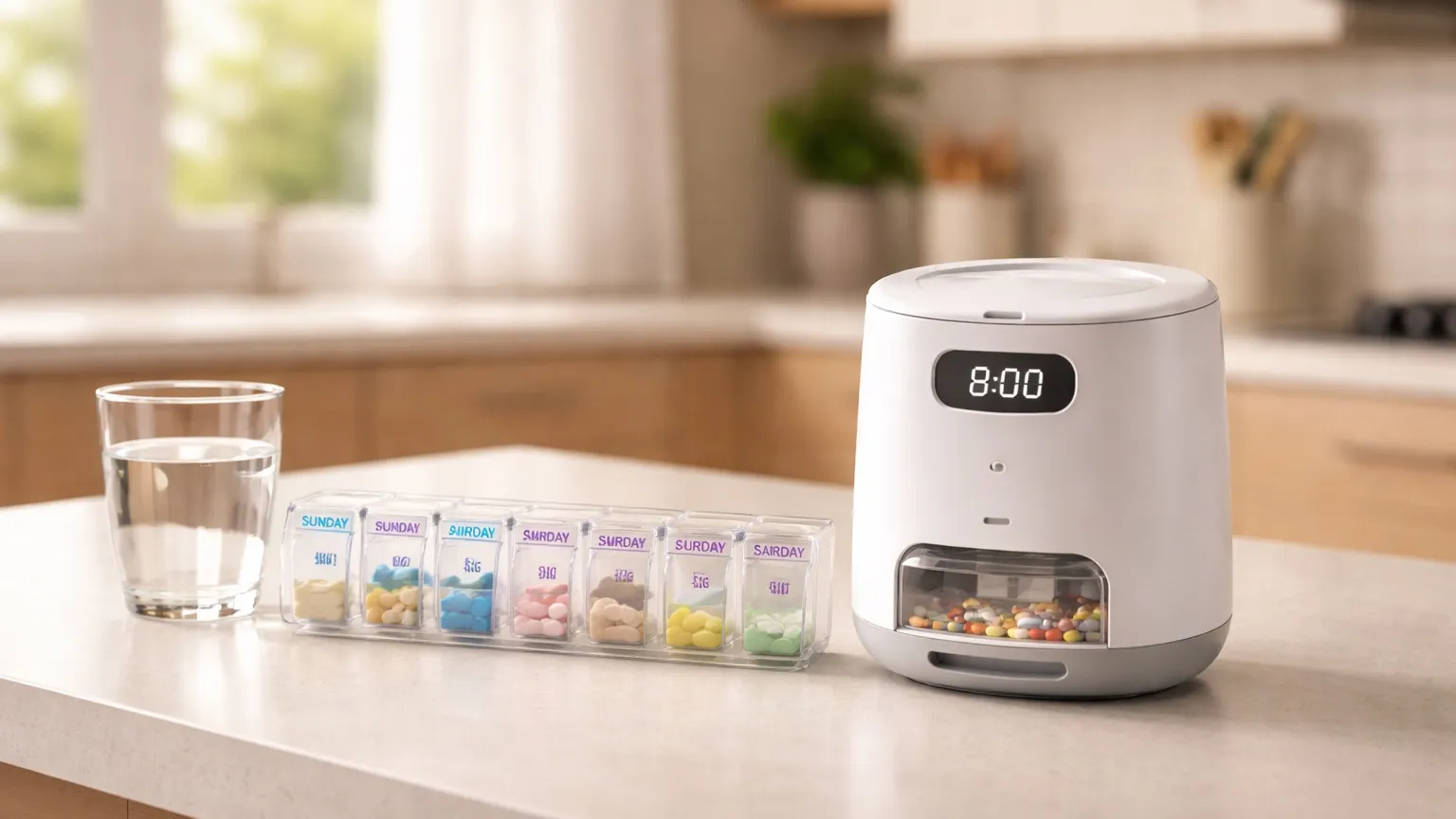
A parent managing several chronic conditions can easily be on eight, ten, or a dozen medications, taken at different times, with different rules about food and timing. Keeping that straight is hard for anyone. When memory starts to slip, it becomes one of the riskiest parts of aging at home — and one of the easiest to mismanage with the wrong tool.
The market sells gadgets: reminder apps, talking bottles, locked dispensers. Some are genuinely useful. But like most of senior safety technology, the device is the last step, not the first. This guide walks the decision in the order that actually works. We’re independent researchers, not clinicians — and the single most valuable step below costs nothing and involves no hardware at all.
1. Start with a medication review, not a gadget
Before optimizing how your parent takes their pills, find out whether they should be taking all of them.
Older adults frequently accumulate medications over years, from different doctors, with no one looking at the whole list at once. The result — polypharmacy — raises the risk of interactions, side effects, and confusion, and is a documented contributor to falls and hospitalizations. (It’s the same factor we flag in our fall prevention guide.)
The fix is a medication review, sometimes called a “brown bag review”: gather every pill bottle, every over-the-counter drug, and every supplement, and bring them to a pharmacist or physician. The goals:
- Identify drugs that are duplicative, no longer needed, or interacting badly.
- Simplify timing where possible — fewer doses at fewer times is dramatically easier to adhere to.
- Flag any medication causing side effects your parent is quietly avoiding.
A shorter, simpler list is easier to take correctly. Simplifying the list often does more for adherence than any dispenser can. Do this first.
2. Understand why adherence actually fails
“My mother forgets her pills” is usually only part of the story. Reminder technology fixes exactly one cause — forgetting — and does nothing for the others. The real reasons people stop taking medication correctly:
- Complexity — too many pills at too many different times.
- Side effects they dislike, so they skip doses on purpose.
- Cost — rationing an expensive prescription.
- Belief it isn’t working, or that they no longer need it.
- Physical barriers — child-proof caps, pills too small to split, vials hard to open with arthritic hands.
- Confusion after a change — a new dose or a swapped generic throws off a routine.
Diagnosing the specific reason matters, because the right solution differs completely. A parent rationing insulin needs a cost conversation, not a beeping box.
3. The tools, from low-tech to high-tech
Once the list is simplified and you know the real barrier, match the tool to the problem.
| Tool | Best for | Watch out for |
|---|---|---|
| Weekly pill organizer (AM/PM compartments) | A capable but forgetful parent | Someone has to fill it correctly each week |
| Phone / clock alarms | Pairs with an organizer for timing cues | Easy to dismiss and forget |
| Connected pill caps / smart organizers | Logging doses, alerting family to a miss | Adds cost; needs charging or batteries |
| Locked automatic dispensers | Cognitive impairment, complex regimens, high-stakes drugs | Overkill for a simple regimen; learning curve |
| Pharmacy blister / multi-dose packaging | Pre-sorted doses by date and time | Less flexible if doses change often |
An easily overlooked low-tech option is pharmacy multi-dose packaging — many pharmacies offer to pre-sort a month of medications into dated, time-labeled packets; ask yours whether it’s available and what it costs. For many families that solves the problem before any gadget enters the picture.
4. Match the tool to the person — cognitive status decides
The single most important variable is your parent’s cognitive ability, because it determines whether a tool helps or just confuses.
- Forgetful but fully capable: a weekly organizer plus alarms is usually enough. Adding a locked dispenser is needless complexity.
- Early memory impairment: a dispenser that releases only the scheduled dose, with missed-dose alerts to family, prevents both skipped and doubled doses.
- Advanced impairment: technology becomes a support for a caregiver, not a tool the parent operates alone. The goal shifts to making your oversight reliable.
A high-tech dispenser given to someone who finds it baffling is worse than a simple box they understand and trust. The fanciest tool your parent won’t use is useless at any price.
5. Safety, interactions, and the data
A few things worth getting right beyond day-to-day dosing:
- Interactions and disposal. New prescriptions, OTC drugs, and supplements can interact; a pharmacist is the cheapest check. Unused medications should be disposed of safely rather than left in a cabinet where they can be taken by mistake — the FDA publishes current disposal guidance.
- The connected-device data question. Smart dispensers and pill caps collect adherence data. Before buying, ask the same questions we raise for any connected senior device: who can see it, is it ever shared or sold, and can the family export or delete it? The consent and data framework we walk through in how to remotely monitor an aging parent applies one-for-one here — a connected pill dispenser is, functionally, another remote-monitoring sensor.
- Keep one current list. A single, up-to-date medication list — shared with every doctor and kept where a caregiver can find it in an emergency — prevents more errors than any app.
Red flags
- A gadget pitched as the whole solution. If the sales copy never mentions a doctor or pharmacist review, it’s solving the easy 10% and ignoring the rest.
- “Clinically proven adherence” with no source. Ask proven how, and compared to what.
- Subscription dispensers with punishing cancellation terms. Same trap as medical alerts — read the multi-year cost and the exit clause.
- Anything that discourages involving the pharmacist. The pharmacist is your most underused, and free, ally here.
What to do next
- Book a medication review with a pharmacist or physician. Bring every bottle, OTC, and supplement.
- Identify the real barrier — forgetting, side effects, cost, complexity, or physical difficulty.
- Ask the pharmacy about multi-dose packaging before buying any device.
- Match the tool to cognitive ability — simplest option that reliably works.
- Keep one shared, current medication list.
- Read our methodology page for how we evaluate dispensers and reminder systems, and check the medication pillar for specific reviews as we publish them.
The most reliable medication routine is usually the simplest one that fits the person — reached by fixing the list first, and choosing the device last.
Further reading
- FDA — Drugs: consumer information on safe medication use and disposal.
- MedlinePlus — Medicines: NIH plain-language guidance on managing medications.
- CDC — Medication Safety: data and guidance on adverse drug events.
- FDA — Consumer Updates: current consumer-facing drug safety articles.
- AARP — Caregiving Resources: caregiver-facing research and guidance.