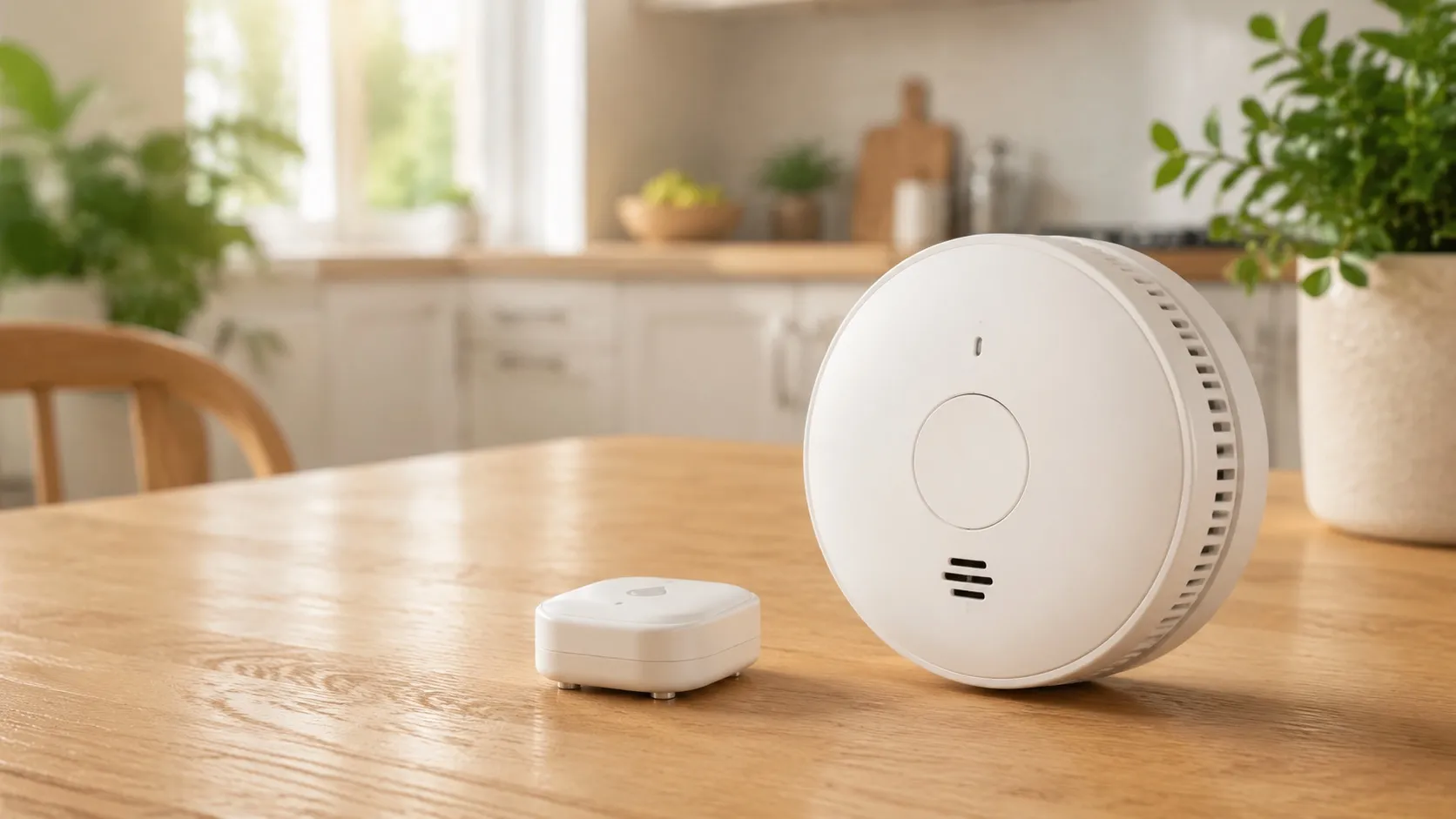
Search “home safety for seniors” and you’ll be offered a catalog of connected sensors — motion detectors, smart plugs, leak monitors, cameras, environmental hubs — most promising to watch over an aging parent automatically. Some of it addresses real risks. Much of it adds blinking lights and phone notifications to a problem that a $20 alarm and an afternoon of decluttering would have handled better.
This guide sorts the home safety layer into what genuinely protects an older adult and what mostly generates noise. We’re independent researchers, and the throughline is simple: the most lethal home risks are old, well-understood, and cheap to address — and they come before anything with an app.
1. The non-negotiable baseline: smoke and carbon monoxide
Before any smart sensor, confirm the basics that prevent the deadliest home emergencies.
Older adults are at disproportionately high risk of dying in a home fire, which is why the U.S. Fire Administration treats them as a priority audience. The fundamentals:
- Working smoke alarms on every level and outside sleeping areas, tested regularly, with batteries that get changed (or ten-year sealed-battery units that remove the task entirely).
- Carbon monoxide alarms near sleeping areas, especially in homes with gas appliances, a furnace, or an attached garage.
- Interconnection so that an alarm anywhere sounds everywhere — critical for a parent who sleeps with a door closed or at the far end of the house.
For a hard-of-hearing parent, standard high-pitched beeps may not wake them; alarms with low-frequency tones or strobe/bed-shaker alerts exist for exactly this. The NFPA’s home fire safety guidance covers placement and testing in detail. Get this layer right before spending a dollar on anything “smart.”
2. The environmental layer: water, temperature, and the stove
The next tier addresses slow disasters — the ones an older adult living alone may not notice until they’ve become expensive or dangerous.
- Water-leak sensors under sinks, behind toilets, and near the water heater catch leaks before they cause damage a parent might not spot or be able to deal with.
- Temperature alerts matter in climates where a failed furnace in winter or failed air conditioning in summer can pose a serious health risk for a frail person. A simple sensor that pings family when the home drops below or rises above a safe range is cheap insurance.
- Stove safety. If cooking-related risk is a concern, an automatic stove shutoff that cuts power after a period of inactivity addresses one of the more common fire-start scenarios without removing the parent’s ability to cook.
These target real, practical hazards — not hypotheticals — and they’re inexpensive. This is where the home safety budget often earns the most.
3. The activity layer — useful, but keep it light
Motion and door sensors that learn a parent’s routine can flag meaningful changes — much less movement than usual, or unusual night-time activity — that sometimes precede a fall or signal illness. That overlaps heavily with the remote monitoring pillar — for the full framework on what to monitor (and when activity sensors actually help versus add noise), see how to remotely monitor an aging parent. We’ll keep it brief here:
- Passive activity sensors are useful for change detection, not surveillance.
- They answer “has something shifted?” without putting a camera in a private home.
- Don’t over-instrument. A handful of well-placed sensors beats a dozen that bury the signal.
4. Smart vs. simple: when connectivity earns its keep
Not every sensor needs to be connected. Connectivity earns its place when it does one of two things:
- Notifies someone who isn’t there — the value of a smart smoke or leak alarm for a distance caregiver is the alert to your phone, not the alarm itself.
- Interconnects devices so a single event triggers the whole system.
If neither applies, a reliable standalone device is often the better choice — fewer batteries, no app outages, nothing to misconfigure. “Smart” is a means, not a goal. A dependable dumb alarm beats a clever one that fails silently when the Wi-Fi drops. The same logic applies elsewhere in the home — see, for example, when a connected pill dispenser earns its place over a $5 weekly organizer, in our medication management guide.
5. The noise problem: alert fatigue is the real failure mode
A common way a home-monitoring setup fails isn’t a missed event — it’s too many events.
When a system fires constant notifications, many of them false alarms, the people receiving them learn to ignore all of them. The one real alert arrives and gets swiped away with the rest. More sensors make this worse, not better.
The discipline that prevents it:
- Monitor only what drives a decision. If you wouldn’t act on it, don’t alert on it.
- Tune sensitivity to cut false positives, even at the cost of occasionally missing a trivial event.
- Consolidate. One well-chosen system beats three overlapping apps each buzzing independently.
Restraint is a feature. A quiet system you trust is worth more than a comprehensive one you’ve muted.
Red flags
- A “complete home safety system” that skips smoke and CO. The fundamentals come first; a hub full of leak and motion sensors with no fire protection has the priorities backward.
- Cloud-dependent safety devices with no offline fallback. A smoke alarm that only works when the internet does is a downgrade.
- Vague data policies on connected sensors. Ask who can see the data, whether it’s shared, and how to delete it.
- High-pressure sales bundling “monitoring” with hardware. Read the multi-year cost and the cancellation terms.
What to do next
- Verify the baseline — working, well-placed, interconnected smoke and CO alarms, with hearing-appropriate alerts if needed.
- Add the environmental layer that fits real risk — leak, temperature, or stove safety.
- Add light activity monitoring only if there’s a specific question it answers.
- Choose connectivity deliberately — connected where it alerts a remote caregiver, simple where it doesn’t.
- Keep the alert load low so the system stays trusted.
- Read our methodology page for how we evaluate sensors, and check the home safety pillar for specific reviews as we publish them.
A safe home for an aging parent usually has fewer gadgets than the catalog suggests — the right few, in the right places, that everyone still pays attention to.
Further reading
- NFPA — Home Fire Safety: alarm placement, testing, and home fire prevention.
- U.S. Fire Administration — Older Adults: fire safety guidance specific to older adults.
- CDC — Older Adult Falls Data: context on home injury risk for seniors.
- NIA — Aging in Place: home safety as part of planning to age at home.
- AARP — Caregiving Resources: caregiver-facing research and guidance.